As I have said in my earlier blog entry, the process of tea tasting and blending is an art. This is how it takes place.
The tea to be tasted is placed in boiling water...normally double the amount that we add to our home brew. The temperature of the water depends upon the sensitivities of the leaves. The temperatures could be anywhere from 170 to 212 degrees centigrade.
The tea is steeped for about 3 to 4 minutes in a cup covered with a lid. The lid is taken off and the brew is ready for tasting. Here both taste and aroma matters hence the smell enhances the taste perception.
The taster begins with a big slurp which lowers the temperature and the brew covers the sensitive taste buds. On the buds some oxygen is pumped in to capture more aroma. Then the brew is ejected in a waste cup and the taster then moves to the next.
Before moving to the next all the attributes are noted down. This is a complex process and only expert tea tasters are able to judge the leaf accurately.
Showing posts with label tasting. Show all posts
Showing posts with label tasting. Show all posts
Saturday, February 1, 2014


Tea Tasting an Art
Tea tasting is an important process in selecting and blending the finest leaves. The sensory apparatus plays an important role in tasting and discovering the right leaves. On the contemporary times this has come to a level of art. The tasting is done by professional and talented people usually from old house involved in the trade of blending the leaves and selling them in the market.
Albeit the tea leaves are derived from the same plant Camellia Sinensis the differing climatic conditions, soil, topography and way of cultivation results in the leaves acquiring properties that are vastly different whence compared with leaf grown in other regions.
The taste buds play the most important role. The nose and the smelling power is as useful is selecting the aroma. Besides the flavoring characteristics and aroma the color of the leaves, size and the type is also taken into consideration. The process involves liquid teas which are tasted in a row one by one.
After the tasting process over the leaves are carefully mixed to form a blend. The blend subscribes to taste, aroma and cost. Hence the companies try to optimize on cost and flavor depending upon the targeted audience.
Thursday, May 8, 2008
Tea: How to enjoy best
If tea tasting and blending are an art so is the way it is prepared. Tea preparation and serving is something perhaps a regular party giver or tea ceremony holder would hold expertise in. It is a hosts delight to serve this hot brew to his or her esteemed guests.
Tea preparation begins with choosing the leaf. In informal circumstances exquisite tea varieties are not a must since cost matters. Taking the weather into consideration strong, dark tea with astringent flavor suits the best, where as in hot weather brew with subtle aroma and sweet taste is more befitting. In the case of former black leaf should be used where as in the case of latter green leaf is apt.
When serving tea in informal occasions, porcelain cups and saucers should be used. The cups brimming with hot beverage should be served on a plain tray along with biscuits and other light snacks.
In case of formal occasions as tea parties and ceremonies, the finest variety of leaf with strong aroma and subtle muscatel taste should be used. A fine example is Darjeeling black and green tea leaf. Premium variety of Assam black leaf also befits the occasion.
The recipe should always be plain and simple with or without milk. Spices and condiments should never be added as they spoil the original flavor of the tea leaf. The connoisseurs would prefer the drink this way.
Special care should be taken whence preparing the brew. The water should be boiled and then allowed to simmer. The leaves should be added during this phase and should be allowed to soak in for some time. As soon as the strong aroma of the leaves starts to emanate from the steaming brew the mixture should be strained.
This recipe gives fine tasting black tea brew. If milk has to be added then it should be done whence serving.
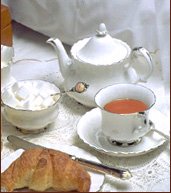
Whence serving exquisitely designed bone china or silver cups and saucers should be used along with kettles of same quality that hold the black leaf and milk. Specially designed containers should be used to hold sugar cubes. The black tea should be gently poured into the cups. Milk should be poured too for those who wish to have it that way. Along with tea, light sandwiches, snacks and biscuits find good accompaniments.
Tea preparation begins with choosing the leaf. In informal circumstances exquisite tea varieties are not a must since cost matters. Taking the weather into consideration strong, dark tea with astringent flavor suits the best, where as in hot weather brew with subtle aroma and sweet taste is more befitting. In the case of former black leaf should be used where as in the case of latter green leaf is apt.
When serving tea in informal occasions, porcelain cups and saucers should be used. The cups brimming with hot beverage should be served on a plain tray along with biscuits and other light snacks.
In case of formal occasions as tea parties and ceremonies, the finest variety of leaf with strong aroma and subtle muscatel taste should be used. A fine example is Darjeeling black and green tea leaf. Premium variety of Assam black leaf also befits the occasion.
The recipe should always be plain and simple with or without milk. Spices and condiments should never be added as they spoil the original flavor of the tea leaf. The connoisseurs would prefer the drink this way.
Special care should be taken whence preparing the brew. The water should be boiled and then allowed to simmer. The leaves should be added during this phase and should be allowed to soak in for some time. As soon as the strong aroma of the leaves starts to emanate from the steaming brew the mixture should be strained.
This recipe gives fine tasting black tea brew. If milk has to be added then it should be done whence serving.
Whence serving exquisitely designed bone china or silver cups and saucers should be used along with kettles of same quality that hold the black leaf and milk. Specially designed containers should be used to hold sugar cubes. The black tea should be gently poured into the cups. Milk should be poured too for those who wish to have it that way. Along with tea, light sandwiches, snacks and biscuits find good accompaniments.
Sunday, April 20, 2008
Tea tasting
The process of selecting tea leaves for blending is referred to as tasting. Tea tasting is an art which is by the virtue of being associated with industry as a blender. The primary senses responsible for tasting are the sense of taste, your taste buds of the tongue and the sense of smell or odor dependent upon your olfactory organs or the nose.
The tea leaves have three basic flavor profiles:
Foreground profile or the top note
Middle profile or the body note
Background flavor or the base note.
These three profiles characterize a leaf flavor and aroma. The aromatic and volatile compounds in the tea leaf are responsible for our taste and odor perception.
Apart from this the physical aspects and look and feel of the tea leaf also comes into the picture.
Mouth Feel for dryness and slipperiness.
Temperature for relative volatility of the constituents.
Method
The tea is prepared in a lidded container such that the volatile components are not freed but infused in the brew. The expert taster should frequently wash hands, rinse his or her mouth with pure water or eat bland biscuit etc. Sometime long hours would be needed to get rid of desensitization that has crept in after hours of tasting.
All the tea tasting happens in milliseconds.
In the tea flavor release process, first the solubility of the leaf in saliva takes place and the solubility components or the aromatic constituents are perceived by the taste buds. The volatile constituents then evaporate and reach the nerve endings in the olfactory region of the nasal cavity.
As stated tea tasting is an expert’s job and lot of hard work is required to understand the taste and aroma of leaves and create a master blend.
Subscribe to:
Posts (Atom)